
We’ve all been there: you log off, close your laptop, or walk out the office door, but your mind stays firmly planted at your desk. You’re sitting on the couch with family or trying to enjoy dinner, yet in the back of your head, you’re replaying an unread email, worrying about tomorrow’s deadline, or mulling over a tense meeting.
In work psychology, this is known as a failure of psychological detachment—the inability to mentally disconnect from work during non-work hours. When the boundary between your professional life and personal life blurs, chronic fatigue and burnout aren’t far behind.
The good news? You don’t need an hour-long spa session to reset your nervous system. You just need five intentional minutes to create a psychological “third space”—a transition boundary that signals to your brain that the workday is officially over.

Why Your Brain Needs a Transition Boundary
Human brains love routines and environmental cues. When you work, your brain operates in a state of high cognitive load and heightened alertness. If you jump straight from a high-stress task directly into your evening routine, your nervous system remains in “work mode.”
Furthermore, our minds are subject to the Zeigarnik Effect—the psychological tendency to remember uncompleted tasks better than completed ones. If you leave open loops at the end of the day, your brain will keep processing them all night.
A deliberate post-work ritual acts as a cognitive circuit breaker. Here is a simple, science-backed 5-minute ritual designed to leave work stress where it belongs: at work.

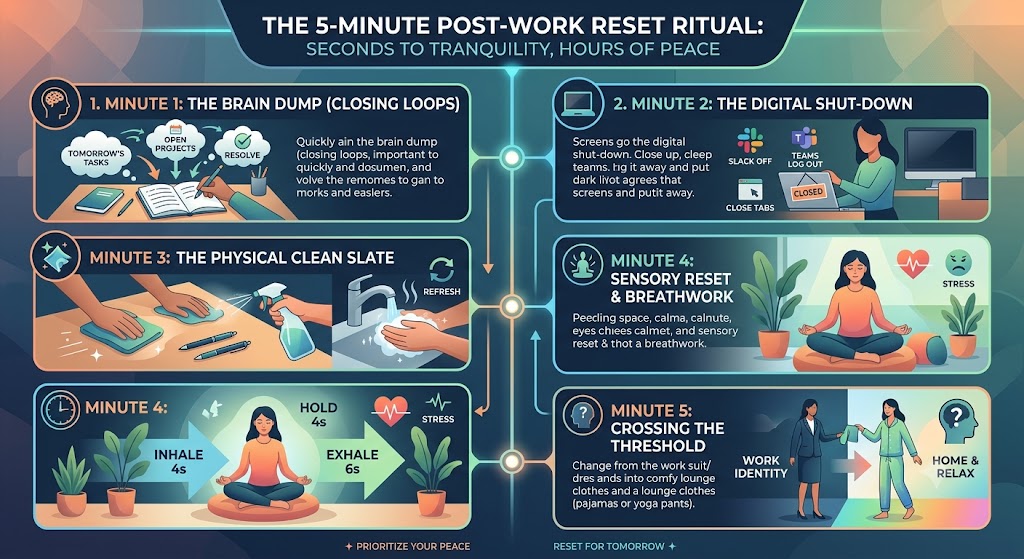
The 5-Minute Post-Work Reset
Minute 1: The “Brain Dump” (Closing the Loops)
Before you stand up from your workspace, take 60 seconds to externalize open tasks.
- Write down your top 2–3 priorities for tomorrow.
- Jot down any lingering thoughts or unresolved issues on a piece of scratch paper or a quick digital note.
- Why it works: By getting these thoughts out of your head and onto paper, you reassure your brain that the information is safe and doesn’t need to be actively processed during your personal time.
Minute 2: The Digital Shut-Down
Physical and digital environment cues are powerful triggers for psychological detachment.
- Close all open browser tabs related to active projects.
- Log off messaging apps (Slack, Teams) and put your work laptop away or close the lid.
- Why it works: Out of sight, out of mind. Removing visual cues prevents passive work thoughts from pulling you back in.
Minute 3: The Physical Clean Slate
Create a quick, tangible boundary that marks the end of the shift.
- Tidy your immediate desk area or wipe down your workspace.
- Wash your hands or face with cold water.
- Why it works: Physical cleansing acts as a somatic ritual. It acts as a clear tactile boundary between “work time” and “home time.”
Minute 4: Sensory Reset & Breathwork
Shift your nervous system from a sympathetic state (“fight or flight”) to a parasympathetic state (“rest and digest”).
- Step away from all screens.
- Take 3–4 deep, slow breaths (inhale for 4 seconds, hold for 4, exhale slowly for 6 seconds).
- Why it works: Prolonged exhales lower your heart rate and signal safety to your nervous system, releasing the physical tension held from workday stressors.
Minute 5: Crossing the Threshold
Finish your transition with a final, conscious act of stepping into your personal role.
- Change out of your work clothes into comfortable home attire.
- Set an intentional mindset: Ask yourself, “How do I want to show up for the rest of my evening?”
- Why it works: Changing your clothes is one of the most effective psychological cues for shifting identities from “employee” to “partner,” “parent,” or simply “yourself.”
Making the Ritual Stick
The key to a successful boundary ritual isn’t perfection—it’s consistency.
- Anchor it: Tie your 5-minute ritual to a habit you already do every day (e.g., right after sending your last email, or right as you step through the front door).
- Protect the boundary: Resist the urge to check work emails “just one last time” after completing your reset. Every time you check, you reset your brain’s clock back to work mode.
By dedicating just five minutes at the end of every shift, you build a resilient wall between your professional demands and your personal peace. Give yourself permission to log off—completely.
Video Spotlight:
If you struggle to leave work at work, you’re not alone—and it might be because your work has become too central to your identity. In this insightful TED Talk, author and workplace expert Simone Stolzoff breaks down why so many of us tie our self-worth to our productivity, and how creating intentional boundaries can help us reclaim our personal lives.
Check out the video below before jumping into today’s 5-minute reset ritual:
Knowledge is only potential power—action is where the real transformation happens! Reading about boundaries is great, but building them takes practice.
Are you ready to reclaim your evenings and keep work stress out of your home? We challenge you to complete the 5-Minute Post-Work Ritual every day for 5 consecutive workdays.
🚀 The 5-Day Post-Work Reset Challenge
How to Join the Challenge
- Pick Your Start Day: Commit to starting this Monday (or your next workday).
- Set a Daily Alarm: Set a reminder on your phone 10 minutes before your shift ends labeled “Reset Time.”
- Follow the 5 Steps:
- 📝 Min 1: Brain Dump & close open loops
- 💻 Min 2: Digital Shut-Down (tabs, apps, laptop closed)
- 🧼 Min 3: Physical Clean Slate (tidy desk, wash hands)
- 🌬️ Min 4: Sensory Reset (4-4-6 breathwork)
- 👕 Min 5: Cross the Threshold (change clothes & shift mindset)
- Track Your Energy: At the end of the 5 days, take note of your stress levels, sleep quality, and how present you felt with family, friends, or hobbies.
💬 Join the Conversation!
Drop a comment below: Which of the 5 steps do you think will be the hardest for you to stick to, and what’s your game plan to overcome it?
Taking the challenge with a coworker? Share this post with them and hold each other accountable!







 A Vibrational Space
Leave a comment