
We’ve all had this exact moment. You have a critical report due, an important client email to draft, or a massive spreadsheet to clean up. You sit down, open the file, and stare at the blinking cursor.
Then, without even realizing how you got there, you are four pages deep into an article about medieval history, reorganizing your desktop folders, or scrolling through social media.
When we procrastinate at work, we usually beat ourselves up about it. We assume it’s a character flaw. We tell ourselves we are lazy, undisciplined, or just lack willpower.
But industrial-organizational psychologists have a secret for you: Procrastination is not a time-management problem. It’s an emotion-regulation problem.
Here is the actual science behind why your brain forces you to stare blankly at your screen—and how you can trick it into getting back to work.

The Battle Inside Your Brain: Amygdala vs. Prefrontal Cortex
To understand procrastination, you have to look at a literal tug-of-war happening inside your head every single workday.
On one side, you have your prefrontal cortex. This is the rational, forward-thinking part of your brain. It understands that if you don’t finish the project today, you’ll be stressed out tomorrow. It values long-term rewards like a paycheck, a promotion, or just peace of mind.
On the other side, you have your amygdala. This is the ancient, emotional, survivalist part of your brain. It doesn’t care about tomorrow; it cares about right now. Its primary job is to protect you from immediate threats.
And here is the glitch in the human operating system: Your amygdala cannot tell the difference between a literal saber-toothed tiger and a stressful Excel spreadsheet.
[Blinking Cursor / Difficult Task]
│
▼
[Brain Interprets as “Threat”]
│
▼
[Amygdala Triggers Fight-or-Flight]
│
▼
[Escape = Quick Dopamine Hit/Scrolling]
When a workplace task feels overwhelming, boring, or triggers a fear of failure, your amygdala interprets that negative emotion as a threat. It panics and demands an escape. Opening a new tab to look at something easy or entertaining is your brain’s way of sprinting away from the threat to find safety and a quick hit of dopamine (the brain’s reward chemical).
The Procrastination Paradox: Procrastination is a coping mechanism. We delay the task to avoid the negative emotions tied to it, gaining instant relief. But that relief is a trap—it quickly mutates into guilt, anxiety, and even more stress.

The “Four Emotional Triggers” of Work Tasks
Psychologist Timothy Pychyl, a leading researcher on procrastination, notes that tasks we avoid usually carry specific emotional triggers. When you are staring at your screen, your task likely suffers from one of these four traits:
- Ambiguity: You don’t actually know what the first step is.
- Frustration / Difficulty: The task is outside your comfort zone, making you feel incompetent.
- Lack of Meaning: You feel like the work is pointless or doesn’t matter.
- Fear of Failure: You are worried the final product won’t be perfect.
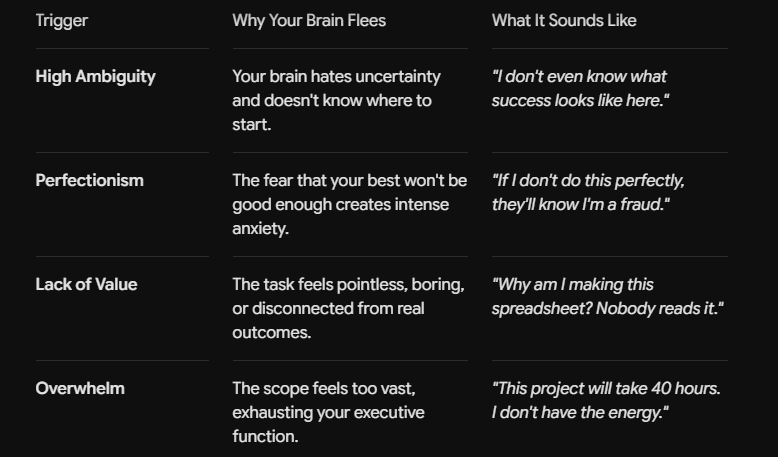
When a task feels ambiguous or difficult, your brain blocks it. You aren’t avoiding the work; you are avoiding the feelings of confusion or inadequacy that come with it.
How to Stop Staring and Start Moving
Knowing the science means you can stop punishing yourself and start using strategies that actually work with your brain’s biology, not against it.

1. Lower the Bar to the Floor (Fight Ambiguity)
If a task is ambiguous, your amygdala flags it as danger. Break the task down until it sounds entirely non-threatening. Don’t write “Work on Q3 Strategy Presentation” on your to-do list. Write “Open PowerPoint and type the title slide.” Once you clear that ridiculously low bar, the momentum usually carries you forward.
2. The 10-Minute Deal (Fight the Amygdala)
Negotiate with your emotional brain. Tell yourself, “I am only going to work on this nightmare spreadsheet for exactly 10 minutes. If I still hate it, I am allowed to close it and walk away.” Because starting is the highest emotional barrier, over 80% of the time you’ll find that once you get past the 10-minute mark, you’re perfectly fine to keep going.
3. Forgive Your Past Self
This sounds like soft advice, but it is deeply rooted in industrial psychology data. Studies show that students and employees who forgive themselves for past procrastination procrastinate less on future tasks. Why? Because self-blame creates more negative emotions, which—you guessed it—triggers the amygdala to avoid work all over again next time.
The next time you find yourself staring blankly at your screen, stop and ask yourself: What emotion am I trying to run away from right now? Name it, shrink the task down to a microscopic first step, and give yourself permission to do a messy first draft. Your prefrontal cortex will thank you.
Video Spotlight:
The Challenge: The 3-Day “Just Start” Sprint
Your inner critic is a terrible manager. It stands over your shoulder, judging your work before the ink even dries or the cursor moves past the first sentence. But here is the secret to breaking the freeze: perfectionism isn’t a high standard—it’s procrastination in a suit. Today, we’re stripping away the illusion of instant brilliance. Welcome to the 3-day “Just Start” challenge!
How It Works (The Rules):
- Duration: 3 consecutive workdays.
- The Target: Identify the one task you’ve been putting off all week (that report, that scary email, or that messy spreadsheet).
- The Daily Mission: Apply the 10-Minute Deal to that specific task at the start of your peak focus hours.
Day 1 – “De-Fang the Threat” : Pick your avoided task. Break it down until the first step is ridiculously easy (e.g., “Create the document and type a bulleted list of 3 ideas”). Set a timer for 10 minutes, do the step, and give yourself permission to stop when the timer goes off.
Day 2 – “Spot the Trigger”: Notice the exact moment your hand tries to open a new tab to escape your work. Stop, take a breath, and name the feeling. Is it ambiguity? Is it fear of failure? Pinpointing the emotion takes away its power.
Day 3 – “The Messy Permission”: Give yourself explicit permission to write a truly terrible first draft. Perfectionism feeds procrastination. Write badly for 10 minutes straight without hitting backspace once.
If this breakdown helped you rethink your workday, subscribe to A Vibrational Space for weekly, research-backed insights on work psychology, productivity, and organizational well-being. Don’t keep the momentum to yourself—share this post with a colleague or friend who’s currently staring at a blank screen!









Leave a Reply