
You didn’t see it, but on your very first day at your job, someone handed you a second blueprint.
It wasn’t the organizational chart showing who reports to whom. It wasn’t the employee handbook detailing the dress code or the 401(k) match. It was an invisible blueprint—a complex web of unwritten rules, unspoken power structures, and emotional currencies.
In the career landscape, technical expertise is just the ante to get into the game. The people who scale the ladder the fastest aren’t always the ones who write the cleanest code, build the prettiest decks, or work the longest hours. They are the ones who can read the invisible blueprint.
Welcome to the world of work psychology. Here is how it quietly shapes your success, and how you can map it to your advantage.
The Power of “Social Capital” (And Why Competence Isn’t Enough)
There’s a classic trap that high achievers fall into: The Meritocracy Myth. We like to believe that if we just put our heads down and do great work, the universe (and our boss) will reward us.
But organizational psychologists often reference a framework called The Principle of Visibility.
Success = Competence x Visibility
If your competence is a 10 out of 10, but your visibility is a 0, your total success score is still zero.
[Great Work Done in Secret] ──> Low Visibility ──> Career Plateau[Strategic Communication] ──> High Visibility ──> Promotion & Influence
The Hack: Stop assuming people notice your output. Start practicing “clean signaling.” Update your manager on wins by framing them around team impact rather than self-praise. For example: “Because we streamlined that pipeline, the team saved five hours of manual data entry this week.”
Navigating the “Idiosyncrasy Credit” System
Have you ever wondered why that one senior colleague can show up to meetings 10 minutes late, wear casual hoodies to client pitches, and push back aggressively on the VP without getting fired?
In social psychology, this is known as Idiosyncrasy Credits. Think of it as a mental bank account of “grace tokens” you earn over time within a group.
- How you deposit credits: Delivering high-quality work, helping colleagues when they are drowning, aligning with company values, and being reliable.
- How you spend credits: Making a mistake, missing a deadline, proposing a radical new idea, or challenging status-quo leadership.
If you try to disrupt the system on day one with zero credits in your account, the organization will reject you. You have to earn the right to be different.
The Pygmalion Effect: Managing Up by Changing Mindsets
One of the most profound psychological phenomena in the workplace is the Pygmalion Effect—the idea that higher expectations lead to an increase in performance, and vice versa.
But this doesn’t just apply from bosses looking down at employees; it works dynamically when you manage up.
If you treat your manager like an incompetent micromanager, your subtle cues—defensiveness in emails, closed body language, holding back information—will actually cause them to micro-manage you more out of anxiety.
- Flip the script: Treat them like a strategic partner who genuinely wants you to succeed.
- The phrasing: “I know how much you care about the quality of this launch, so I wanted to share this draft early to get your strategic eye on it.”
By explicitly labeling them as a “strategic partner,” you trigger a subconscious desire in them to live up to that positive expectation.
The Hidden Tax: Overcoming Proximity Bias
As the professional world embraces hybrid and remote work models, a new psychological hurdle has entered the invisible blueprint: Proximity Bias.
This is our evolutionary habit of favoring people who are physically close to us. Humans are wired to trust what they can see and touch. Study after study shows that remote workers, despite often being more productive, face lower rates of promotions and smaller bonuses than their in-office peers simply because they lack “hallway equity.”
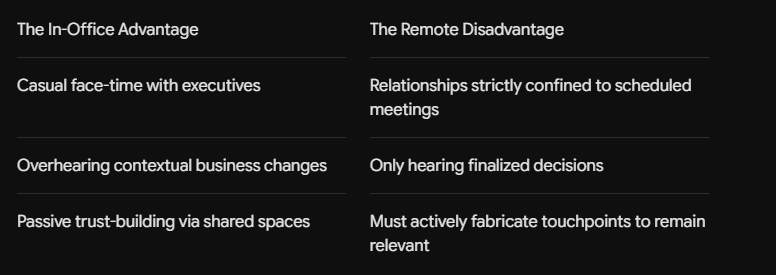
If you work remotely, you cannot afford to be passive. You must build digital proximity by turning your camera on, participating in non-work chat channels, and setting up virtual 15-minute coffee chats that have nothing to do with immediate deliverables.
Becoming the Architect of Your Career
The invisible blueprint isn’t malicious; it’s just human nature dressed up in business casual.
When you stop treating workplace politics like a chore and start viewing work psychology as the software running the office hardware, you gain an immense competitive edge. You stop reacting to friction and start predicting it.
After all, building the career you want isn’t just about mastering the tools of your trade—it’s about mastering the psychology of the people using them.
Mapping Your Next Move
Ultimately, navigating the workplace isn’t about manipulating the system—it’s about understanding it. The technical skills on your resume might open the door, but your psychological agility is what keeps you in the room and elevates you to the next level.
By pulling back the curtain on the invisible blueprint, you transition from a passive spectator to an active architect of your professional journey. Stop working in secret, start building your social capital, and recognize the unspoken human needs driving your organization. When you align your daily execution with how people actually think and feel, your career success stops being a game of chance and starts becoming a strategic certainty.
Video Spotlight
Want a challenge? Try the 7-Day “Blueprint Master” Challenge!
For the next week, step away from your spreadsheets and code to actively map the psychological architecture of your office. Here is your daily mission tracker:
- Day 1: Audit Your Visibility. Look at your calendar. If you did great work today, who actually knows about it besides you? Find one low-key, professional way to share a win with your manager before Friday.
- Day 2: Check Your Credit Balance. Take an honest inventory of your Idiosyncrasy Credits. Are you deep in the green, or have you been spending grace tokens without making deposits? Commit to one high-value, helpful act for a teammate today.
- Day 3: Flip the Pygmalion Switch. Identify one person at work you have a tense relationship with. Today, consciously treat them with high positive expectations. Note how they respond to your shift in energy.
- Day 4: Defeat Proximity Bias. If you are remote, schedule a 15-minute virtual coffee chat with a peer just to catch up. If you are in the office, grab lunch or coffee with someone outside your immediate department to build “hallway equity.”
- Day 5: Practice “Clean Signaling.” When updating someone on a project today, strip out self-praise. Frame the update entirely around how your work solves their problems or saves the team time.
- Day 6: Shadow the Power Structures. In your meetings today, look past job titles. Who do people look at before they speak? Whose opinion carries the most unspoken weight? Identify the real influencers.
- Day 7: The Blueprint Review. Look back at the week. Which psychological levers felt most natural to pull, and how can you integrate them into your permanent career strategy?
Let me know how it went in the comments 🙂







 A Vibrational Space
Leave a comment