

We’ve all been there. You walk into the office (or log onto Slack), and there they are.
Maybe it’s the micromanager who wants to approve your font choices, the hyper-competitive peer who turns every status update into a humblebrag marathon, or the colleague who treats every mild inconvenience like a five-alarm fire.
It’s easy to write these people off as “difficult” and spend your lunch break venting to your work bestie. But here’s the cold, hard truth: your ability to navigate these personalities dictates your career trajectory just as much as your actual technical skills.
The good news? You don’t need to change who they are. You just need to understand the psychological machinery running beneath the surface.
The Real Reason Workplace Conflict Happens
Most people think office drama is caused by bad attitudes. In reality, it usually comes down to a psychological concept known as the Fundamental Attribution Error.
When we make a mistake—like missing a deadline—we blame our circumstances (“I had three urgent meetings and my internet cut out!”). But when a colleague misses a deadline, we assume it’s a character flaw (“They are lazy and disorganized”).
The Hack: The next time a coworker triggers you, pause and ask: “What structural or environmental stressor could be making them act this way?” Shifting your perspective from “they are a jerk” to “they are under pressure” changes your response from defensive to strategic.
Decoding the 4 Workplace Archetypes
Psychologists often categorize workplace behaviors into distinct operational styles. Once you recognize the core driver of each archetype, you can speak their language.
The Controller (Driven by Certainty)
- How to spot them: Impatient, hyper-focused on results, loves metrics, dislikes small talk.
- The Psychology: Their deepest fear is losing control or looking incompetent.
- How to win them over: Don’t bring them problems without bringing two potential solutions. Keep your updates brief, lead with the bottom line, and give them options so they retain the final decision.
The Approver (Driven by Harmony)
- How to spot them: Patient, fiercely loyal, hates conflict, slow to make big decisions.
- The Psychology: They value team cohesion and psychological safety above all else.
- How to win them over: Do not rush them or corner them in public. Before dropping a major change on their desk, ask for their input early. Build a personal rapport before talking business.
The Analyzer (Driven by Accuracy)
- How to spot them: Quiet, detail-oriented, loves spreadsheets, skeptical of “gut feelings.”
- The Psychology: They view mistakes as catastrophic. They need data to feel secure.
- How to win them over: Never wing it. If you’re pitching an idea, bring the receipts—data, timelines, and case studies. Give them time to process information instead of demanding an immediate answer.
The Promoter (Driven by Recognition)
- How to spot them: Enthusiastic, highly social, ideas-focused, sometimes skips the details.
- The Psychology: They thrive on validation, social connection, and being seen as innovative.
- How to win them over: Validate their ideas publicly before steering them back to the operational details. Let them run the brainstorms, but help them build the structure to execute.

The Power of “Ego-Affirmation”
We like to think of the office as a place of pure logic, but it’s actually an emotional ecosystem. When people act out, it’s usually because their ego feels threatened.
If you need to deliver tough feedback or push back on a bad idea, use the psychological principle of Ego-Affirmation. Before you dismantle an idea, anchor the person’s value to something secure.
- Instead of: “That timeline is totally unrealistic and won’t work.”
- Try: “I love how ambitious this vision is, and your creativity on this project has been huge. Let’s look at the data to see how we can phase this out so the team doesn’t burn out.”
By validating their identity first (creative, ambitious), you disarm their neurological threat response, making them far more receptive to your critique.

The Mirroring Effect: Building Instant Trust
Want to get along with someone who seems completely different from you? Use behavioral mirroring.
This doesn’t mean mimicking their every move like a mime. It means subtly matching their communication cadence. If your boss speaks in slow, measured, data-heavy sentences, don’t burst into their office talking at a mile a minute with high-energy hand gestures. Match their volume, tempo, and vocabulary level.
Neurons in our brains called mirror neurons naturally fire when we see someone acting like us. Subconsciously, mirroring signals: “I am safe. I am like you.”
The Ultimate Workplace Cheat Sheet
When in doubt, apply this quick mental framework to your daily interactions:
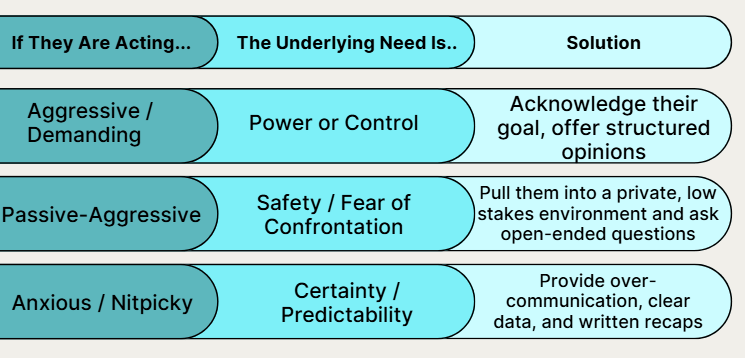
Key Strategies for Success
Map the Power Structure: Observe how decisions are made in meetings. Note who your manager listens to, their nonverbal cues (e.g., nodding or smiling), and whose ideas gain traction.
Build Authentic Relationships: Approach colleagues with genuine curiosity. Networking across different departments and having casual catch-ups builds an allied support system that advocates for you.
Support Your Boss Proactively: Solve problems before they escalate. By anticipating your leader’s needs and providing resourceful ideas, you make their job easier and establish yourself as an invaluable contributor.
Communicate Strategically: Ensure your hard work is visible and that you communicate clearly and succinctly. Use curiosity over confrontation when navigating conflicts.
Commit to Growth: Continuous learning is critical as it enables individuals to adapt to the ever-changing landscape of personal and professional challenges. By embracing a growth mindset, we open ourselves to new experiences and skills that enhance our ability to innovate and solve problems.
In Conclusion
Mastering office dynamics isn’t about being fake or manipulative; it’s about practicing behavioral agility. When you stop taking people’s workplace quirks personally and start treating them as data points, you don’t just get along with anyone—you become the person everyone wants to work with.
Video Spotlight
Think you can handle some homework? Take the 7-Day “Flip the Script” Challenge!
For the next week, pick your most challenging coworker and change your strategy using these daily psychological pivots:
- Day 1: The Attribution Shift. The next time they annoy you, force yourself to write down two external pressures (tight deadlines, stressful bosses) that might be causing their behavior.
- Day 2: Identify the Archetype. Quietly observe them today. Are they a Controller, Approver, Analyzer, or Promoter?
- Day 3: Speak Their Language. Match their communication cadence. If they send brief emails, reply in bullet points. If they love data, bring facts.
- Day 4: The 10-Second Mirror. In a meeting, subtly match their posture or physical energy for ten seconds to build subconscious rapport.
- Day 5: Affirm the Ego. Find a genuine opportunity to validate their skill or ambition before offering a critique or counterpoint.
- Day 6: Over-Communicate. If they are an anxious Analyzer or Controller, send a proactive status update before they have to ask you for it.
- Day 7: The Debrief. Reflect on how your relationship shifted. Did their attitude change, or did your perspective make them easier to manage?
Let me know how it goes in the comments!









Leave a Reply